
It sounds like you need a dual-voltage power supply. There really
isn't such a thing as "negative" voltage... for example if you have a
9V power supply, you could say that 4.5V is a "virtual ground", and
then 0V would appear as "negative" relative to your "virtual ground",
and the 9V wire would appear like 4.5V relative to "virtual ground"
(again, which is actually 4.5V relative to 0V wire).
A simple circuit is shown here, though you can get more complex ICs
that are more efficient, this has few parts and is simple:
http://electronics.stackexchange.com/a/79317/34413
So with something like that in place, you connect your arduino GND pin
to the "virtual ground" and the PWR pin to the "virtual 4.5V"
(assuming you have a 5V tolerant Arduino). Then using transistors, you
can pulse your analysis cell with your "positive" and "negative"
polarity pulses.
Stripping voltammetry is another interesting and related technique,
where you hold a voltage for some time, then slowly alter the voltage
and watch the current response... basically you plate ions to the
electrode, and then slowly drive them off. There are characteristic
current curves, since different ions electrolyse at different
voltages, so you can determine minute amounts of metals and their
concentrations (if you have standards to calibrate against). There are
also interesting impedance spectrometry techniques... where you
generate an electrical wave, watch the current flowing, then do this
while changing/scanning through a range of frequencies. Lots of neat
stuff! It's all electron interactions at some point! So might as well
learn to use them!
On Tue, Nov 17, 2015 at 4:50 AM, Markos <markos@c2o.pro.br> wrote:
> Hi,
>
> I'm trying to implement a conductivity meter with the Arduino board. My
> intention is to keep the electronic circuit as simple as possible.
>
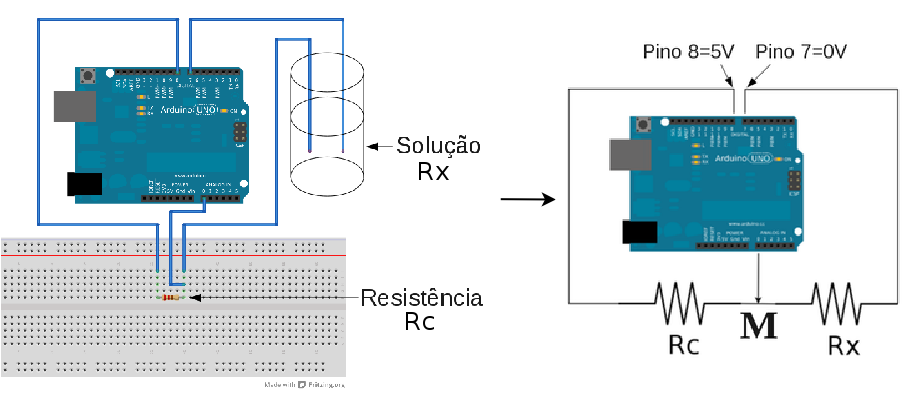
> I'm only using a voltage divider as shown:
> http://www.c2o.pro.br/hackaguas/figuras/condutivimetro_00_bb.png
>
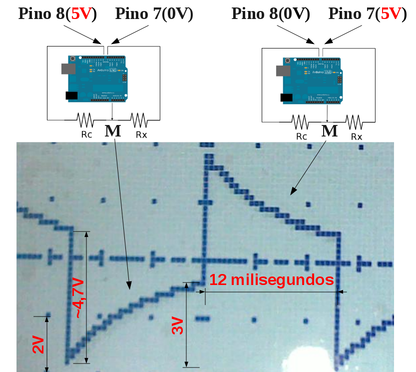
> The alternating pulses are generated by switching the signals from pins 7
> and 8 of Arduino:
> http://www.c2o.pro.br/hackaguas/figuras/condutividade_efeito_frequencia_01.png
>
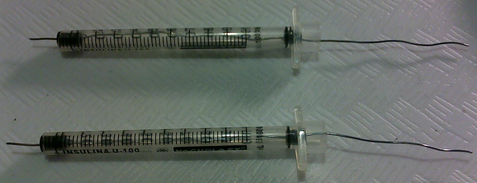
> For now I'm using two steel wires as electrodes:
> http://www.c2o.pro.br/hackaguas/figuras/eletrodos_00.png
>
> My intention is to be able to control via software some measuring
> parameters, such as electrode polarization time. And adjust these parameters
> on the fly depending on the sample concentration range.
>
> Recently I started to read some papers about bipolar pulse technique:
> http://pubs.acs.org/doi/abs/10.1021/ac60285a015
>
> The bipolar pulse technique for measuring solution resistance minimizes the
> effects of both the series and parallel cell capacitances. The technique
> consists of applying two consecutive voltage pulses of equal magnitude and
> pulse width but of oposite polarity to a cell and measuring the cell current
> precisely at the end of the second pulse. (Source: Peter Kissinger, William
> R. Heineman, Laboratory techniques in electroanalytical chemistry)
>
> Does anyone has any experience with this conductivity measuring technique?
>
> Thanks for any tip,
> Markos
>
> --
> -- You received this message because you are subscribed to the Google Groups
> DIYbio group. To post to this group, send email to diybio@googlegroups.com.
> To unsubscribe from this group, send email to
> diybio+unsubscribe@googlegroups.com. For more options, visit this group at
> https://groups.google.com/d/forum/diybio?hl=en
> Learn more at www.diybio.org
> --- You received this message because you are subscribed to the Google
> Groups "DIYbio" group.
> To unsubscribe from this group and stop receiving emails from it, send an
> email to diybio+unsubscribe@googlegroups.com.
> To post to this group, send email to diybio@googlegroups.com.
> Visit this group at http://groups.google.com/group/diybio.
> To view this discussion on the web visit
> https://groups.google.com/d/msgid/diybio/564B2299.2050204%40c2o.pro.br.
> For more options, visit https://groups.google.com/d/optout.
--
-Nathan
--
-- You received this message because you are subscribed to the Google Groups DIYbio group. To post to this group, send email to diybio@googlegroups.com. To unsubscribe from this group, send email to diybio+unsubscribe@googlegroups.com. For more options, visit this group at https://groups.google.com/d/forum/diybio?hl=en
Learn more at www.diybio.org
---
You received this message because you are subscribed to the Google Groups "DIYbio" group.
To unsubscribe from this group and stop receiving emails from it, send an email to diybio+unsubscribe@googlegroups.com.
To post to this group, send email to diybio@googlegroups.com.
Visit this group at http://groups.google.com/group/diybio.
To view this discussion on the web visit https://groups.google.com/d/msgid/diybio/CA%2B82U9K7ZNTXEoeSA%2B-odNn7mSZuycD%2BW57pJwwyCnoiJK9OBw%40mail.gmail.com.
For more options, visit https://groups.google.com/d/optout.
Re: [DIYbio] Conductivity measurements with Bipolar Pulse



Subscribe to:
Post Comments (Atom)
0 comments:
Post a Comment