
The Ancient Digger |

| Monday Ground Up: Two Architectural Gems in Rome, Italy Posted: 04 Jul 2010 09:37 PM PDT Roman architecture  is classical and hardly practical. It could be described as masculine in a sense, with a hint of solitude. No matter how we interpret the structure, we can all agree that it exhibited a solid foundation and architectural form. is classical and hardly practical. It could be described as masculine in a sense, with a hint of solitude. No matter how we interpret the structure, we can all agree that it exhibited a solid foundation and architectural form.The Baths of Caracalla and the Arch of Titus are two such structures that on one hand side represent honor and resolve, but on the other relaxation and educational output. Baths of Caracalla Roman Emperor Caracalla  reigned over Rome in 211 however his reign exemplified the true jealously of brothers. Caracalla killed his brother Geta in 212 shortly after they both succeeded Septimius Severus reigned over Rome in 211 however his reign exemplified the true jealously of brothers. Caracalla killed his brother Geta in 212 shortly after they both succeeded Septimius Severus to the imperial throne in 211. The Baths of Caracalla, of course, had been created and named after the Emperor Caracalla in his honor. to the imperial throne in 211. The Baths of Caracalla, of course, had been created and named after the Emperor Caracalla in his honor. The Roman bathhouse created a location of leisure, or civic amenity, for all those in attendance. Incredibly inventive in their own right, the baths were fashioned with underground heating that provided heat for the bathers. Roman bathhouses like Thermae in Bath, England, have been found all over Rome, however the Baths of Caracalla are the most remarkable. The Baths of Caracalla are located in Caelian Hill  and were constructed around 211, but weren't finished until 217. Close to 1600 individuals would flock to the baths at a time, meeting in the various chambers to partake in activities. The Caladarium included pools with very hot water. The Tepidarium, of course, included lukewarm water and the Frigidarium contained cold water. There was also an outdoors pool called the Natatio. For those that wished to stay dry, the stadium and gymnasium served for exercise purposes and Greek and Latin libraries provided an intellectual atmosphere. and were constructed around 211, but weren't finished until 217. Close to 1600 individuals would flock to the baths at a time, meeting in the various chambers to partake in activities. The Caladarium included pools with very hot water. The Tepidarium, of course, included lukewarm water and the Frigidarium contained cold water. There was also an outdoors pool called the Natatio. For those that wished to stay dry, the stadium and gymnasium served for exercise purposes and Greek and Latin libraries provided an intellectual atmosphere. Farnese Hercules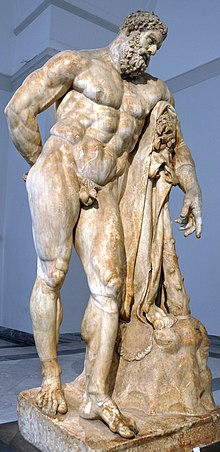 The Baths of Caracalla operated until the 6th century when Goths destroyed the aqueducts supplying the water to the baths. The Caracalla Baths suffered enormous decay over the centuries, and during the 16th century, the Farnese family  removed almost every marble fitting to decorate their palace. The Farnese family also inherited several sculptures during the time of Pope Paul III , which became a part of their private collection. Those sculptures can now be found in Naples. removed almost every marble fitting to decorate their palace. The Farnese family also inherited several sculptures during the time of Pope Paul III , which became a part of their private collection. Those sculptures can now be found in Naples. Access is limited to certain areas to avoid damage to the mosaic floors, although such damage is already clearly visible. Also, a total of 22 well-preserved columns from the ruins are found in the church of Santa Maria in Trastevere, taken there in the 12th century. Access is limited to certain areas to avoid damage to the mosaic floors, although such damage is already clearly visible. Also, a total of 22 well-preserved columns from the ruins are found in the church of Santa Maria in Trastevere, taken there in the 12th century.During the 20th century, Benito Mussolini introduced the idea of open air operas at the Baths of Caracalla. It's been questioned, however, that the vibrations from the singer's voices are damaging the structure. Nonetheless, Pavarotti Domingo and Carreras performed at the Caracalla Baths in 1990, on the eve of the World Cup. Arch of Titus Traditionally, Roman arches were constructed as a focal point for the procession of victorious armies coming home. There are close to 34 arches built in Rome, the Arch of Titus being the oldest. 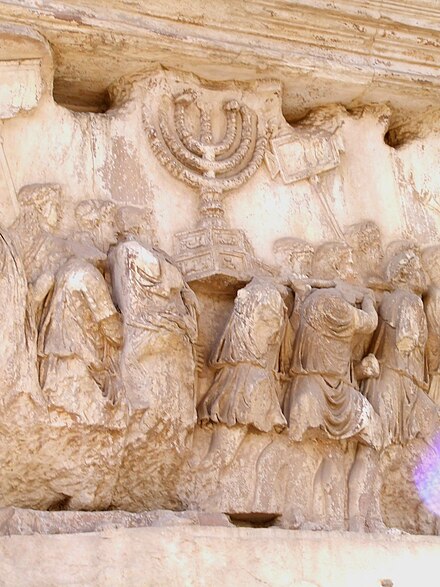 Detail from the Arch of Titus showing spoils from the Sack of Jerusalem The Arch of Titus was created in 81 CE, shortly after Titus's death and commissioned by his brother Domitian who succeeded him as emperor. The Arch of Titus is a celebration of Titus's victories including the struggle against Jewish rebels that culminated in the capture of Jerusalem in 70 CE. Sculptures depict the looting of the temples of Jerusalem; some believe the Ark of the Covenant was taken at this time. There are several scenes carved on the Arch of Titus, one being a new god parading in his chariot, crowned by victory; another in the vault of the arch shows Titus ascending into the heavens on the wings of an eagle.  The Arch in 1744, before restoration. Painting by Canaletto. Over the centuries, the Arch of Titus changed considerably. Many believe there existed a sculpture of Titus on the top of the Arch, however it had been removed during the Middle Ages, and replaced by further sculptures depicting the times. It wasn't until 1822 that Giuseppe Valadier restored the site, dismantling the arch and reconstructing it in its present form. Also check out: Roman Achievements in Law and Engineering  Read More: Monday Ground Up: Roman Achievements in Law and Engineering The Catholic Church During Charlemagne  Read More: Monday Ground Up: The Catholic Church During Charlemagne Picture Sources  |
| Rise of the World's First Hominids Posted: 04 Jul 2010 09:59 AM PDT The Middle Awash Area of Ethiopia  The Middle Awash area of Ethiopia The Middle Awash area of Ethiopia  is the most persistently occupied place on Earth. Members of our lineage have lived, died, and been buried there for almost six million years. Now the bones of hominids is the most persistently occupied place on Earth. Members of our lineage have lived, died, and been buried there for almost six million years. Now the bones of hominids   are eroding out of the ground. are eroding out of the ground. In the Afar desert of Ethiopia, there are a lot of ways to bite the sand so to speak. There is disease, of course. One can also perish from wild animal attack, snakebite, falling off a cliff, or in a shoot-out between one of the Afar clans and the Issa people across the Awash River to the east. But life is fragile all over Africa. What is special here is the occasional durability of the deceased's remains. The Afar Basin sits smack atop a widening rip in the Earth's crust. Over time, volcanoes, earthquakes, and the slow accumulation of sediments have conspired to bury bones and then, much later, disgorge them to the surface as fossils. The process is ongoing. In August 2008 a young boy was taken by a crocodile in Yardi Lake, in an area of the Afar known as the Middle Awash. Read More: The Middle Awash Area of Ethiopia and the Rise of the World's First Hominids. Courtesy of Auron from Edutainment  |
| You are subscribed to email updates from Ancient Digger To stop receiving these emails, you may unsubscribe now. | Email delivery powered by Google |
| Google Inc., 20 West Kinzie, Chicago IL USA 60610 | |


0 comments:
Post a Comment