
New updates apply for the GenoConSample App for GenoCon2
It's a great chance for your own DIY synbio design: GenoCon pays for the synthesis of the DNA and its transformation into a real plant!
We hope you might be interested in entering, and could spread the word.
Dear DIYbio members,
We've been updating GenoCon2 in preparation for the start of the competition on October 8. You can try it out now!
(more about that below.)
We are very happy to be giving out the award trophies Saturday 9/29 for the first GenoCon 2010 Challenge!

These Transgenic Arabidopsis plants were designed to be resistant to formaldehyde by a winner of the first GenoCon 2010 Challenge. http://genocon.org/assignment-2012/assignment-b/background-2012-challenge-b/ (the other images in this gallery are after the plants have been dried and encased in acrylic for preservation.)
"Formaldehyde is known as a harmful substance to the human body and cause sick house syndrome. If there was a plant which is able to absorb formaldehyde and remove it effectively, we might be able to prevent sick house syndrome by putting the plant in the room. However, general plants has little function to absorb formaldehyde. In GenoCon, we would like you to design DNA sequence to add such function to a model plant."
"The GenoCon2 Challenge B assignment builds on the same Design Challenge as in GenoCon 2010: design a DNA sequence conferring to the model organism Arabidopsis thaliana the functionality to eliminate and detoxify airborne formaldehyde.
Though this function has been successfully engineered in previous work, your task is to increase the performance of formaldehyde absorption. DNA sequences which improve upon previous designs or which use completely new methods to add this function to the plant to absorb and remove formaldehyde effectively are both accepted."
"Formaldehyde is known as a harmful substance to the human body and cause sick house syndrome. If there was a plant which is able to absorb formaldehyde and remove it effectively, we might be able to prevent sick house syndrome by putting the plant in the room. However, general plants has little function to absorb formaldehyde. In GenoCon, we would like you to design DNA sequence to add such function to a model plant."
"The GenoCon2 Challenge B assignment builds on the same Design Challenge as in GenoCon 2010: design a DNA sequence conferring to the model organism Arabidopsis thaliana the functionality to eliminate and detoxify airborne formaldehyde.
Though this function has been successfully engineered in previous work, your task is to increase the performance of formaldehyde absorption. DNA sequences which improve upon previous designs or which use completely new methods to add this function to the plant to absorb and remove formaldehyde effectively are both accepted."
About the updates for GenoCon2 Challenge A:
Part of the process involves forking your own javascript app from
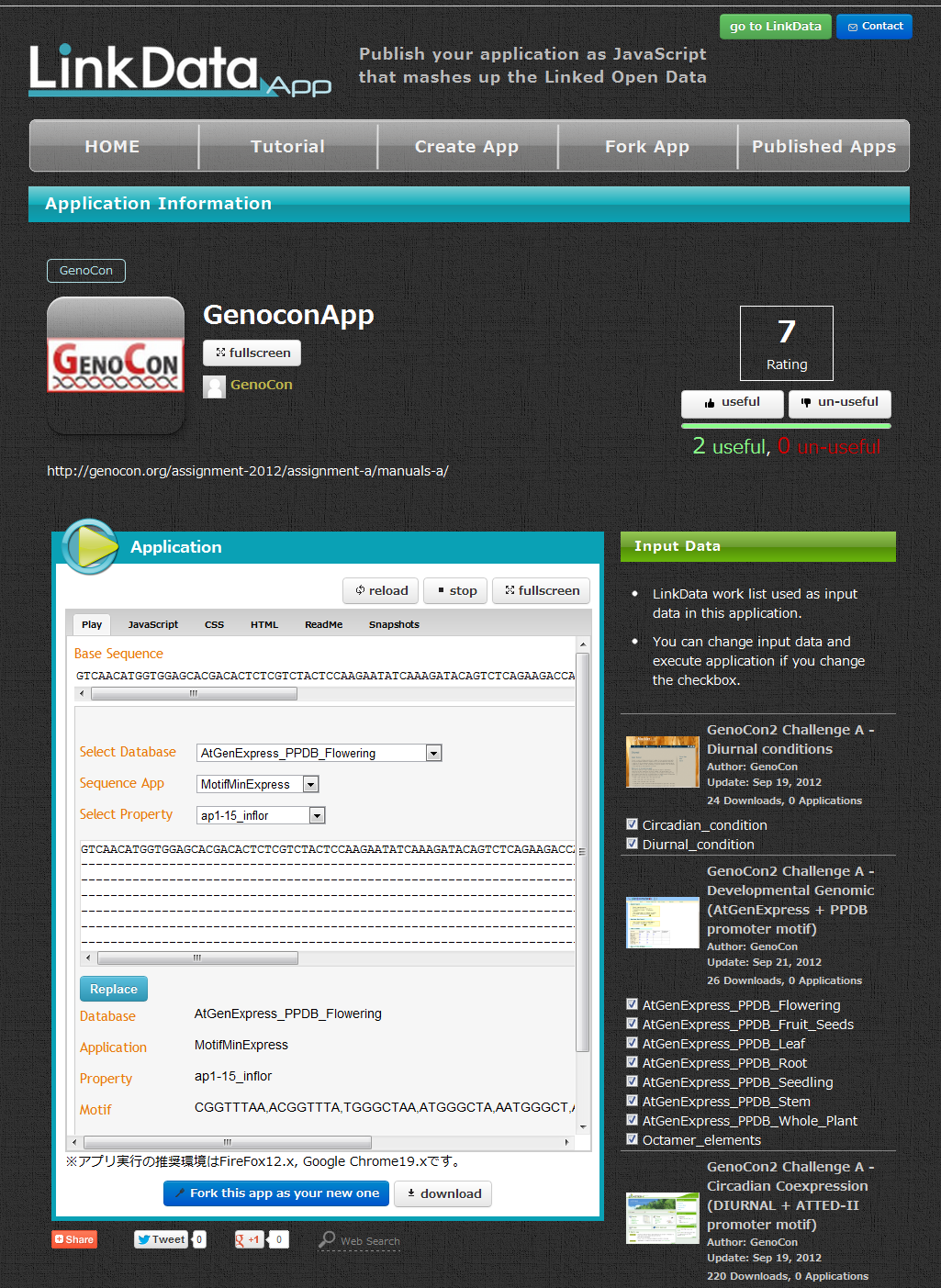
(#1) Additional sample data was added.
・ATTED-II sequence motifs with gene expression data under developmental conditions of AtGenExpress (existing data)
・ATTED-II sequence motifs with gene expression data under circadian conditions of DIURNAL (new data)
・PPDB sequence motifs with gene expression data under developmental conditions of AtGenExpress (new data)
・PPDB sequence motifs with gene expression data under circadian conditions of DIURNAL (new data)
We made two new functions;
(#2) MotifMaxCircadian

(#3) High Chart

(#4) Motif View was also added to the GenoCon App.

Please check out further details and links at
Sincerely,
David Gifford
You received this message because you are subscribed to the Google Groups "DIYbio" group.
To post to this group, send email to diybio@googlegroups.com.
To unsubscribe from this group, send email to diybio+unsubscribe@googlegroups.com.
To view this discussion on the web visit https://groups.google.com/d/msg/diybio/-/_3K64UQ0b6sJ.
For more options, visit https://groups.google.com/groups/opt_out.


0 comments:
Post a Comment